Rice tuned to each topping
- Tabelog Bronze #481: 4.1pts · 2026
- Opinionated About Dining Top Restaurants in Japan Recommended · 2026
- Tabelog 100 #52: 4pts · 2025
- Tabelog Bronze · 2025
- Opinionated About Dining Top Restaurants in Japan Ranked #397 · 2024
Rice set to the fish
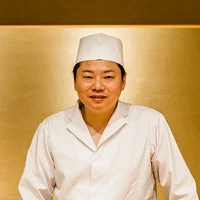
The rice changes with the topping under Chef Tsubasa Otan at Tsubasa in Kitakyushu, where Kokura-style sushi gives the counter its discipline. Otan shapes the meal from a narrow grammar: local Kyushu seafood, salt, sudachi, and shari adjusted in size and temperature piece by piece. The work is not built around range. It is built around how little can be added before the fish begins to lose its own line.
Otan trained for eight years at Morita, the Kokura sushi house also written as Mori Ta, whose local lineage is tied to Ten Zushi and to a pre-war sushi culture rooted in the ground taste of the fish. That apprenticeship matters here because Tsubasa does not read as a concept moved into sushi language. It reads as a station held in one place, with authorship visible from the counter. Founded in 2012 and later moved to its second-floor Uomachi address in July 2016, the restaurant has kept its focus close: Kokura-style squid nigiri, seasonal nigiri, and the progression that leads the hand there.
Salt, sudachi, and shari temperature
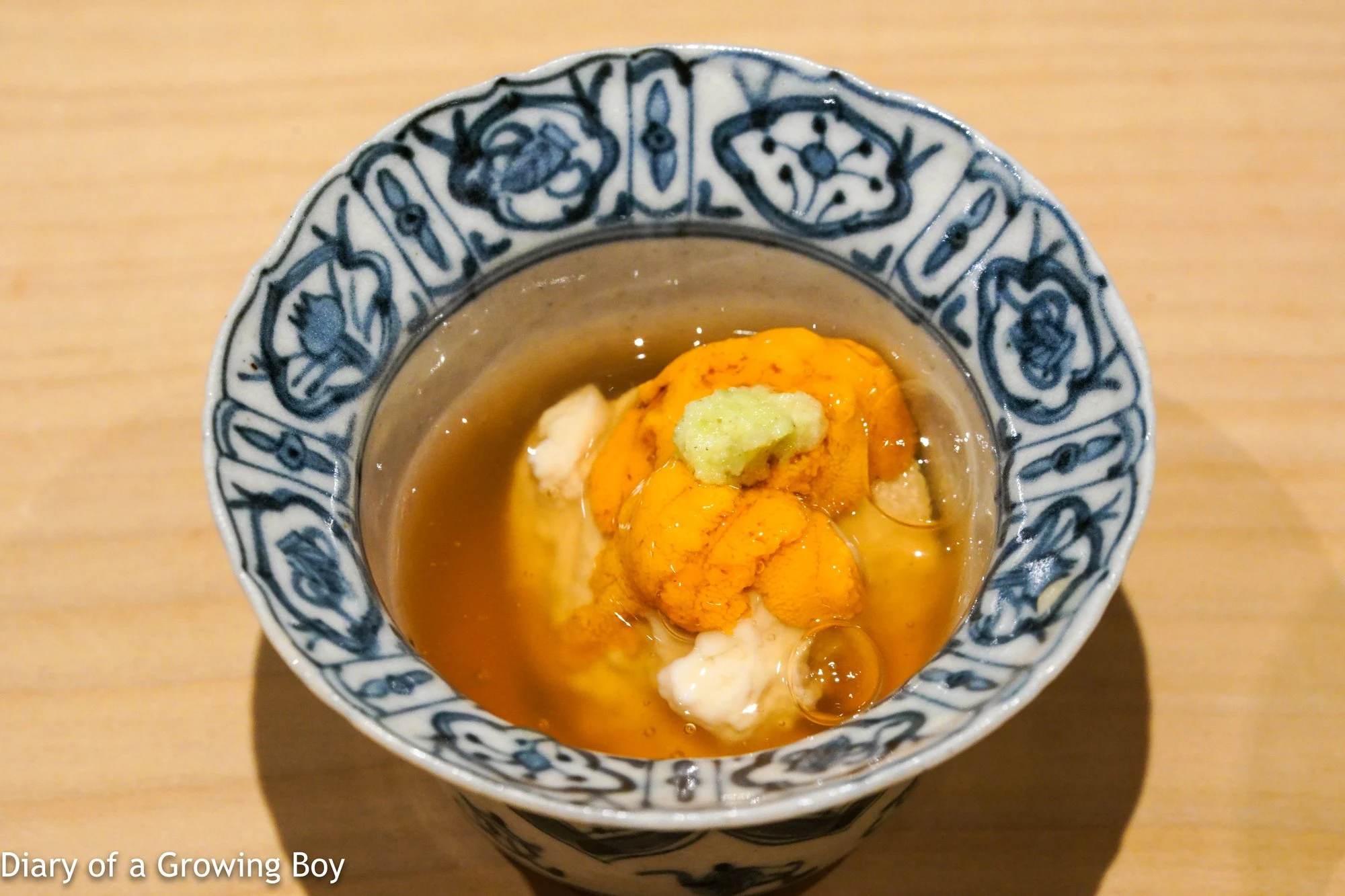
Kokura-style sushi at Tsubasa begins before the nigiri arrives. The meal commonly moves through small plates before the sushi sequence, a local structure that lets texture and seasoning gather rather than announce themselves at once. The kitchen favors Kyushu waters and uses salt, sudachi citrus, and measured umami in place of heavier soy emphasis. On squid, the cut matters: a decorative scoring gives the surface more places to meet salt and citrus, then the rice underneath carries a temperature chosen for that topping.
That temperature variation is one of the clearest signs of Otan's method. Warmth, size, pressure, and seasoning shift according to the fish, so the hand does not repeat a shape simply because the menu repeats the category. Hirame may take salt kombu; red sea cucumber appears as a small salty preparation; seasonal fish come forward within the same restrained frame. The beverage program follows the food rather than competing with it, with sake, shochu, and wine chosen for clean edges against citrus, salt, and rice.
A counter built for attention
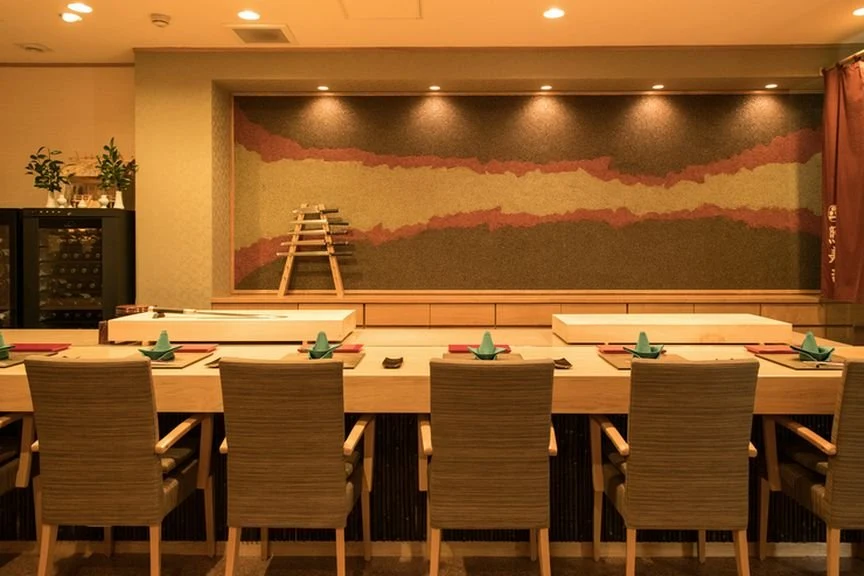
The room keeps the field of view small. Tsubasa is an 8-seat counter in a sukiya-style space shaped by a Kyoto-trained tea-house carpenter, with wood, woven mats, soft light, and little visual noise between guest and bench. The materials have the calm of a tea room, but the working rhythm belongs to sushi: rice lifted, fish set down, a brush or pinch applied, the piece placed before it cools out of its intended register.
In that quiet, the counter does its proper work. It makes distance difficult. Guests see the pressure of Otan's fingers, the angle of the slice, the moment sudachi enters and disappears. The seasonal nigiri selection changes, but the discipline holds around Kokura-style squid nigiri and the local seafood that gives Tsubasa its reason for being.
Questions
Frequently asked
Who cooks at Tsubasa?
Chef Tsubasa Otan shapes the sushi at Tsubasa and works with Kokura-style technique drawn from his eight-year training at Morita, also written as Mori Ta.
What is Tsubasa known for?
The restaurant is known for Kokura-style sushi built around Kyushu seafood, salt, sudachi, and rice tuned piece by piece to the topping. Kokura-style squid nigiri and a seasonal nigiri selection are part of its focus.
What kind of meal does Tsubasa serve?
The meal commonly begins with small plates before moving into the sushi sequence. The food follows a restrained local grammar rather than a broad menu.
What is the dining room like?
Tsubasa is an 8-seat counter in a sukiya-style space on the second floor of its Uomachi address. The room uses wood, woven mats, and soft light, with little visual noise between guest and counter.
Is booking required?
Reservations are essential, and the dress code is smart casual.
The field
How it compares
| Place | Cuisine | Notes | Awards |
|---|---|---|---|
| Tsubasa | Kokura-Style Sushi | Kokurakita Ward, Heiwa Dori area, $$$ | · |
| Blue Hill at Stone Barns | Farm-to-Table Fine Dining | Tarrytown | Michelin 2 Stars, World's 50 Best |
| DSTAgE | Avant-Garde Spanish Tasting Menus | Madrid | Michelin 2 Stars |
| Oryori Sato | Seasonal Japanese Omakase | Kitakyushu | · |
| Piazza Duomo | Modern Piedmontese Fine Dining | Alba | Michelin 3 Stars, World's 50 Best |
| Pujol | Modern Mexican Fine Dining | Mexico City | Michelin 2 Stars, World's 50 Best |
| Teruzushi | Entertainment Sushi | Kitakyushu | · |
In residence
Featured in

Similar places
Farm-to-Table Fine Dining
Blue Hill at Stone Barns
Tarrytown, United States
★★ · 50 Best
Avant-Garde Spanish Tasting Menus
DSTAgE
Madrid, Spain
★★
Seasonal Japanese Omakase
Oryori Sato
Kitakyushu, Japan
Modern Piedmontese Fine Dining
Piazza Duomo
Alba, Italy
★★★ · 50 Best
Modern Mexican Fine Dining
Pujol
Mexico City, Mexico
★★ · 50 Best
Entertainment Sushi
Teruzushi
Kitakyushu, Japan