Cafe d'Alsace
- 01CuisineAlsatian Brasserie
- 02CityNew York City, United States
From the people index
Recommended by
One trusted voice points here.
- Wine Spectator · Tier 2
- Wine Spectator Best of Award of Excellence · 2026
Second Avenue at 88th: Where the Upper East Side Gets French Without the Formality
The stretch of Second Avenue running through the upper eighties is not where most Manhattan diners begin their search for French regional cooking. That search more commonly ends in Midtown, where places like Le Bernardin and Per Se define French dining at its most tightly controlled. But Alsatian cooking has never been about that register. It is a border cuisine, the product of a territory that passed between France and Germany multiple times across two centuries, and its character is defined by that negotiated identity: choucroute, tarte flambée, riesling, and a reverence for pork in every cured, smoked, and brined form. Cafe d'Alsace at 1703 Second Avenue operates inside that tradition, and the Upper East Side context matters more than it might seem at first.
This part of Manhattan has historically supported a quieter, more neighbourhood-rooted dining culture than Midtown or the Lower East Side. The density of long-running brasseries, European wine bars, and family-oriented restaurants along Second and Third Avenues reflects a residential population that eats out frequently but without the event-dining framing of destinations further south. Cafe d'Alsace fits that rhythm. It is the kind of place that functions as a regular rather than a reservation, where the logic of the meal is comfort and repetition rather than novelty.
Alsatian Cooking in a City That Mostly Misses It
French regional specificity is underrepresented in New York relative to the city's overall French dining offer. The Michelin-level French houses, including Jungsik New York and Atomix in adjacent tasting-menu territory, operate at a price tier and formality level that bears no relation to what Alsace actually produces. The region's cooking is generous and caloric, built around dishes that require time and accumulated flavour rather than refinement. Choucroute garnie, the dish most associated with Alsatian tables, is a slow-cooked assembly of sauerkraut, smoked meats, sausages, and often a ham hock, and it has no obvious home in New York's current restaurant landscape outside a handful of brasserie-format venues. That scarcity gives Cafe d'Alsace a positioning that it did not have to manufacture.
The beer program has been a consistent point of reference for the restaurant. Alsace is the French region most directly engaged with beer culture, sharing both geography and ingredients with the German brewing tradition across the Rhine. A serious curation of Alsatian and Belgian beers alongside the expected wine list places Cafe d'Alsace in a dual-beverage tradition that most French restaurants in New York either ignore or handle as an afterthought. For broader context on the American dining landscape that produced this kind of regional specialist, venues like Bacchanalia in Atlanta and Emeril's in New Orleans each demonstrate how regional European cooking takes on a distinct character when translated into American contexts.
The Brasserie Format and What It Actually Demands
The brasserie is a specific French institution with a specific set of expectations. It is not a bistro, which operates at smaller scale and tighter margins. It is not a gastronomic restaurant in the tasting-menu sense. A brasserie is a mid-to-large-format room, open long hours, serving a fixed set of regional plates alongside a full bar, and producing them consistently across lunch and dinner services. The format has survived in French cities because it offers something that higher-end dining cannot: accessibility without compromise on flavour or tradition.
In New York, maintaining that format requires resisting the pressure to modernise the menu toward current trends or to raise price points to levels that undercut the casual-frequenter logic that makes brasseries work. The comparison set for Cafe d'Alsace is not Masa or Alinea in Chicago. It is the set of French regional venues that have held a neighbourhood audience over time without converting to event-dining economics. That is a harder commercial case to make in Manhattan's current cost environment, and venues that sustain it over years are worth noting for that reason alone.
For readers planning time across multiple American cities, the regional-dining logic that applies to Cafe d'Alsace recurs in different forms at places like Lazy Bear in San Francisco, Single Thread Farm in Healdsburg, and Providence in Los Angeles, each anchored in a particular culinary tradition and place-specific identity rather than generic fine-dining positioning. On the international side, Alsatian cooking's Franco-German hybridity has a loose parallel in the border cuisines of Europe, a dynamic explored at different levels at Alain Ducasse at Louis XV in Monte Carlo and 8 1/2 Otto e Mezzo Bombana in Hong Kong.
The Neighbourhood as Context for the Experience
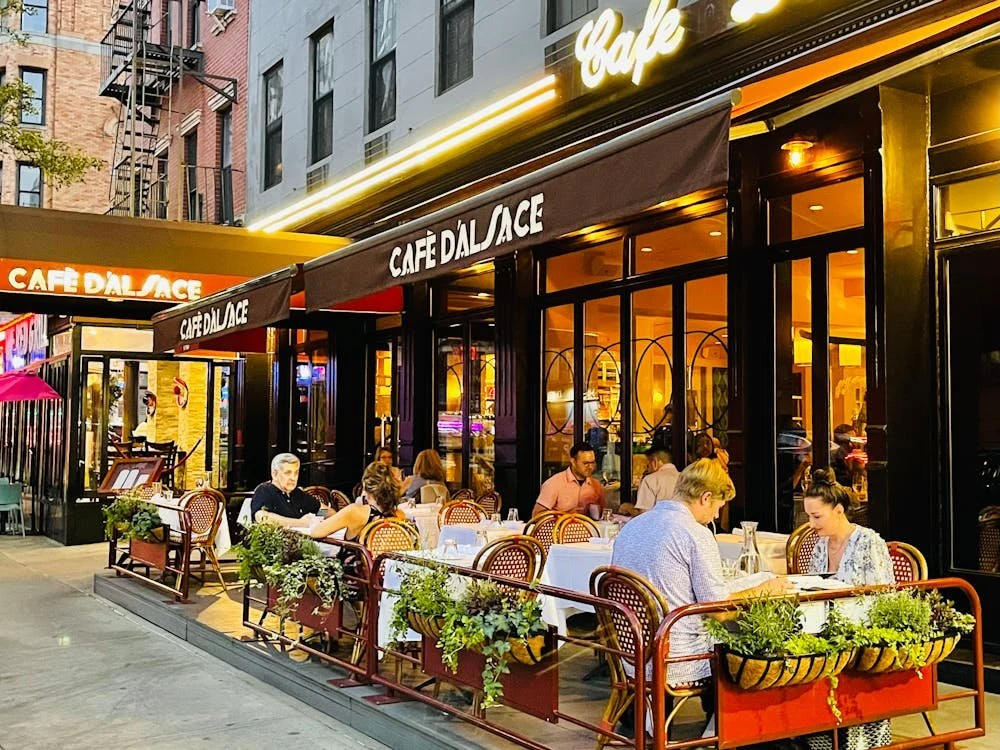
Arriving at 1703 Second Avenue, the surrounding blocks give the meal its frame. This is Yorkville, a neighbourhood with a documented German and Central European immigrant history that shaped its eating culture through much of the twentieth century. The Alsatian restaurant here is not an arbitrary placement. Alsace sits at the intersection of French and German culinary worlds, and Yorkville historically provided the audience and the reference point for that kind of cooking. As that immigrant demographic dispersed, the restaurants that remained became something closer to institutions than novelties. Cafe d'Alsace operates in that downstream position, in a neighbourhood whose culinary identity has thinned but not entirely disappeared.
For a full orientation to the city's restaurant offer at every price tier, including tasting-menu destinations and neighbourhood regulars, see our full New York City restaurants guide. Venues like Blue Hill at Stone Barns in Tarrytown, The French Laundry in Napa, Addison in San Diego, and The Inn at Little Washington each represent the American end of the French-influenced fine-dining arc that Cafe d'Alsace sits well outside, by design.
Know Before You Go
- Address: 1703 Second Avenue, New York, NY 10128 (Upper East Side, Yorkville)
- Format: Brasserie-style, suited to casual weeknight dining and weekend lunches
- Beverage focus: Alsatian and Belgian beer program alongside a regional wine list
- Neighbourhood: Walking distance from the 86th Street subway stop on the Q/4/5/6 lines
- Booking: Reservation availability varies; the neighbourhood format supports walk-in attempts, particularly mid-week
Questions
Frequently asked
How expensive is Cafe d'Alsace?
Cafe d'Alsace is listed at a price level of $$$.
Where is Cafe d'Alsace and what does it serve?
Cafe d'Alsace is in Upper East Side-Yorkville, New York City, serving Alsatian Brasserie.
The field
How it compares
| Place | Cuisine | Notes | Awards |
|---|---|---|---|
| Cafe d'Alsace | Alsatian Brasserie | Upper East Side-Yorkville, $$$ | · |
| Atomix | Modern Korean Tasting Menu | New York City | Michelin 2 Stars, World's 50 Best |
| Daniel | Modern French Fine Dining | New York City | Michelin 1 Star, World's 50 Best |
| Eleven Madison Park | Contemporary Plant-Based Fine Dining | New York City | Michelin 3 Stars, World's 50 Best |
| Jungsik New York | Modern Korean Fine Dining | New York City | Michelin 3 Stars, World's 50 Best |
| Kabawa | Modern Caribbean Prix Fixe | New York City | World's 50 Best |
| Le Bernardin | French Seafood Fine Dining | New York City | Michelin 3 Stars, World's 50 Best |
Similar places
Modern Korean Tasting Menu
Atomix
New York City, United States
★★ · 50 Best
Modern French Fine Dining
Daniel
New York City, United States
★ · 50 Best
Contemporary Plant-Based Fine Dining
Eleven Madison Park
New York City, United States
★★★ · 50 Best
Modern Korean Fine Dining
Jungsik New York
New York City, United States
★★★ · 50 Best
Modern Caribbean Prix Fixe
Kabawa
New York City, United States
50 Best
French Seafood Fine Dining
Le Bernardin
New York City, United States
★★★ · 50 Best